

Executive Opening Show for Kronospan
Creating a large-scale opening experience through hyper-real material simulations, delivering four minutes of synchronized LED and projection content in less than three weeks.
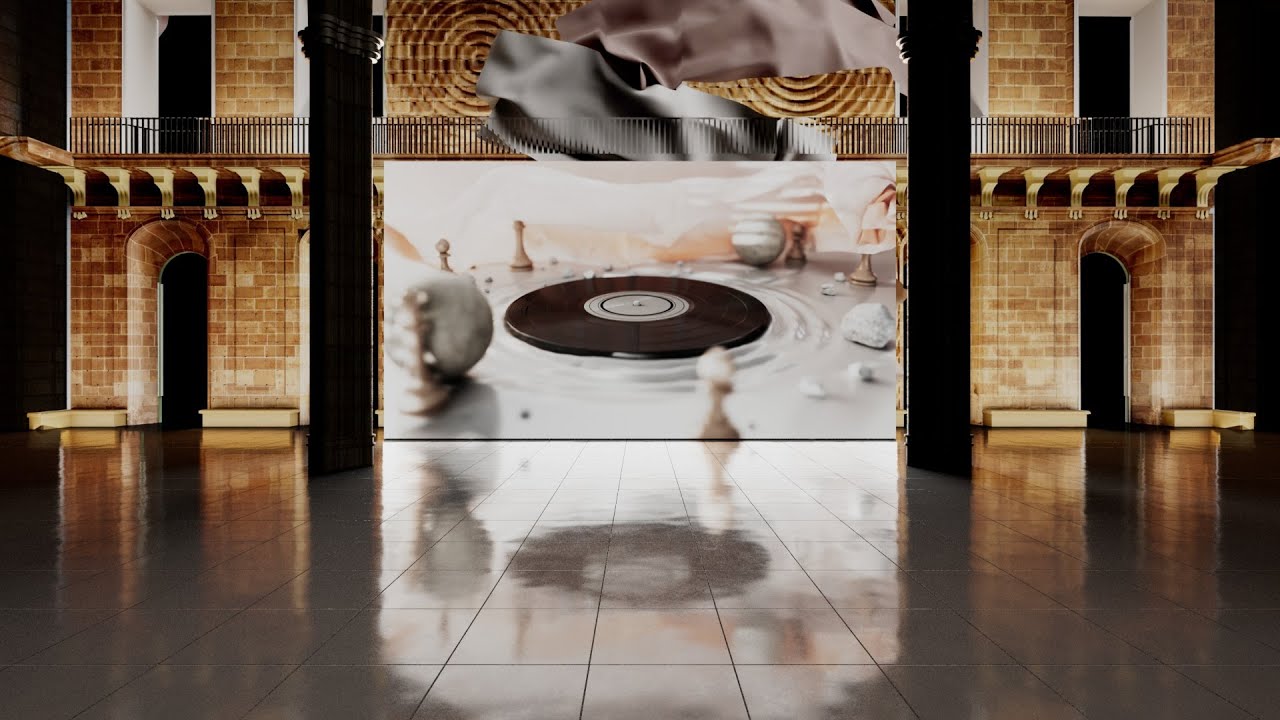
Kronospan invited more than 1,800 guests from over 70 countries to Barcelona for its largest corporate event of the year. The opening show introduced the company's future vision through a combination of LED content and architectural projection mapping.
I was responsible for designing and producing the complete opening sequence for the central LED stage while coordinating the development of the accompanying projection content.

CLIENT
Kronospan
FORMAT
LED
Projection Mapping
Projection Mapping
AUDIENCE
1,800+
VENUE
Hyatt Hotel
Barcelona, Spain
Barcelona, Spain
TIMELINE
20 Days
ROLE
Creative Execution, Animation, Look Development, Art Direction, Team Coordination
When the Schedule Looks Impossible
When I first opened the brief, my first thought was:
"There is no way this can be done in time."
The next morning, production started.
The next morning, production started.
The scope included almost four minutes of content across two independent visual systems, all within less than 20 days. Every scene relied on complex material simulations, detailed look development and high-resolution rendering.
It quickly became clear that one person couldn't realistically deliver this amount of work in time. The project was split between two designers. I created the complete opening sequence and was responsible for the overall visual direction of the project, while the second designer focused on animating the remaining part based on the visual language I had established.
The biggest challenge wasn't creating beautiful visuals.
It was delivering an ambitious creative vision on time.
It quickly became clear that one person couldn't realistically deliver this amount of work in time. The project was split between two designers. I created the complete opening sequence and was responsible for the overall visual direction of the project, while the second designer focused on animating the remaining part based on the visual language I had established.
The biggest challenge wasn't creating beautiful visuals.
It was delivering an ambitious creative vision on time.
Design
Principles
Principles
These principles shaped every visual decision and kept both parts of the show connected as one experience.
Materials.
Wood, stone and fabric were the core of the story. Each material was explored in detail and became the foundation of the entire visual work.

Contrast.
Rigid became soft.
Heavy became light.
Natural became architectural.
The entire show was built on contrast transformation.
Heavy became light.
Natural became architectural.
The entire show was built on contrast transformation.

Motion.
Every flows.
Nothing feels static.
Every transition grows naturally from the previous one.
Nothing feels static.
Every transition grows naturally from the previous one.

Hyper-realism.
Close-up details textures, light and surface imperfections bring material the life and make them feel real.

From Brief to
Final Frames
Final Frames
With the visual direction approved, the focus shifted to production.
Every scene went through the same process: animatic, look development, simulations, lighting, rendering and refinement. The biggest challenge wasn't creating individual shots, but making sure they all felt connected while staying on schedule.
By breaking the project into clear stages, it became possible to keep the quality high without slowing down production.
Every scene went through the same process: animatic, look development, simulations, lighting, rendering and refinement. The biggest challenge wasn't creating individual shots, but making sure they all felt connected while staying on schedule.
By breaking the project into clear stages, it became possible to keep the quality high without slowing down production.
Brief
Project brief, music, storyboard and creative references provided by the client.
Animatic
The complete opening sequence was blocked out in four days, allowing the client to approve pacing and composition before production.
Look Development
Materials, lighting, colors and camera language were established to define the visual identity of the show.
Every transformation was built through custom simulations, from flowing fabric to wood and stone interactions.
Every transformation was built through custom simulations, from flowing fabric to wood and stone interactions.
Lighting & Rendering
Each shot was refined to emphasize texture, depth and realistic material response.
Final Production
Animation, rendering and compositing came together into the final opening experience shown live in Barcelona.

Fast production isn't about working faster.
It's about making the right decisions early.
It's about making the right decisions early.
Two Independent Visual Systems
The opening experience was built across two completely different display systems.
One piece of content played on the central LED screen.
The other was projected onto the architectural backdrop surrounding the stage.
Although they were produced separately, both had to feel like one visual experience.
One piece of content played on the central LED screen.
The other was projected onto the architectural backdrop surrounding the stage.
Although they were produced separately, both had to feel like one visual experience.
The LED screen told the story.

The projection mapping expanded the world around it.
Neither system competed for attention.
Each one had a different role.
Together they created one seamless opening experience.
Each one had a different role.
Together they created one seamless opening experience.
The LED screen was responsible for the main visual narrative.
Projection mapping wasn't there to repeat the same content. Its role was to extend the stage, add depth and support the story without distracting from the main action.
Designing both systems together was essential to make the entire show feel connected.
Designing both systems together was essential to make the entire show feel connected.
Balance Before Spectacle
The LED screen naturally attracts most of the audience's attention because of its brightness and contrast.
Instead of competing with it, the projection mapping was designed to support the main content by extending space, adding atmosphere and reinforcing each transition.
The goal wasn't to create two separate experiences.
It was to make them feel like one.
Instead of competing with it, the projection mapping was designed to support the main content by extending space, adding atmosphere and reinforcing each transition.
The goal wasn't to create two separate experiences.
It was to make them feel like one.
Execution
Under Pressure
Under Pressure
A project like this only works when decisions are made early.
The complete animatic was built and approved within the first four days. That gave me a clear direction before investing time into simulations, lighting and rendering.
From that point, production became a matter of execution rather than constant redesign. Most of the visual decisions made during the animatic stage remained unchanged all the way to the final delivery.
That approach made it possible to deliver a technically demanding project without sacrificing quality.
The complete animatic was built and approved within the first four days. That gave me a clear direction before investing time into simulations, lighting and rendering.
From that point, production became a matter of execution rather than constant redesign. Most of the visual decisions made during the animatic stage remained unchanged all the way to the final delivery.
That approach made it possible to deliver a technically demanding project without sacrificing quality.
20 Days Total
4 Days
Animatic
Client Approval
Client Approval
16 Days
Production of the complete 2-minute opening sequence
LED Content + Projection Mapping
Content Developed in parallel
LED Content + Projection Mapping
Content Developed in parallel
Live Event
Reflection
Looking back, I'm probably most proud of how calm the project feels today.
At the time, it felt almost impossible.
Less than twenty days, complex simulations, two independent visual systems and a huge amount of production work.
Looking at the final result now, none of that pressure is visible anymore.
And that's probably the best outcome I could hope for.
At the time, it felt almost impossible.
Less than twenty days, complex simulations, two independent visual systems and a huge amount of production work.
Looking at the final result now, none of that pressure is visible anymore.
And that's probably the best outcome I could hope for.
Beautiful visuals are expected. Delivering them under pressure is what makes the difference.
